Rajnath Singh Urges China to Sustain Positive Momentum in Bilateral Ties, Avoid Fresh Complications
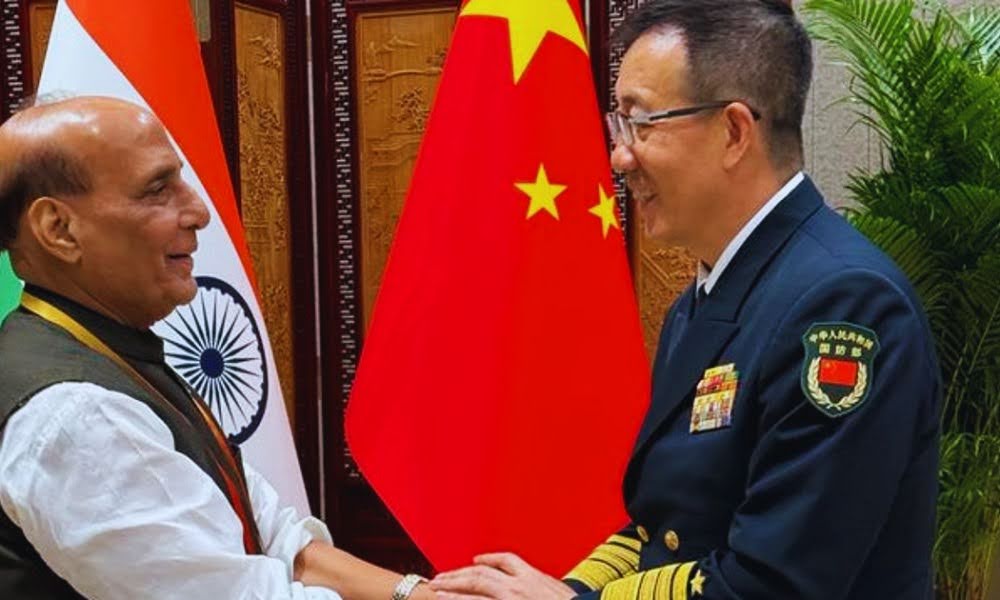
Defence Minister Rajnath Singh proposed a four-point plan aimed at reducing border tensions and strengthening diplomatic relations with China.
The proposal came during his bilateral meeting with Chinese Defence Minister Admiral Dong Jun on the sidelines of the Shanghai Cooperation Organisation (SCO) Defence Ministers’ meeting held in Qingdao, according to sources.
Key Elements of the Four-Point Formula
The plan outlined by Singh includes adherence to the 2024 disengagement agreement, sustained efforts to de-escalate the situation, accelerated progress towards demarcating and delimiting the border, and the use of the existing special representative mechanism to prepare new processes for managing differences and enhancing ties.
During the discussion, Singh also raised concerns about Pakistan-sponsored cross-border terrorism. Referring to Operation Sindoor, Singh stated that it represents “India’s principled position” in addressing terrorism-related challenges.
Singh Emphasises Positive Momentum in Ties
After the meeting, Singh shared a picture on X (formerly Twitter) and underlined the importance of preserving the recent positive momentum in India-China relations.
He also expressed happiness over the resumption of the Kailash Mansarovar Yatra after nearly six years.
“Held talks with Admiral Dong Jun, the Defence Minister of China, on the sidelines of SCO Defence Ministers’ Meeting in Qingdao. We had a constructive and forward-looking exchange of views on issues pertaining to bilateral relations. Expressed my happiness on restarting of the Kailash Mansarovar Yatra after a gap of nearly six years.
It is incumbent on both sides to maintain this positive momentum and avoid adding new complexities to the bilateral relationship,” Singh tweeted.
As a goodwill gesture, Singh presented Admiral Dong Jun with a Madhubani painting from Bihar, known for its intricate line drawings and vibrant colours originating from the Mithila region.
China’s Response and Official Communication
According to a readout from China, India has shown unwillingness to seek confrontation and is committed to enhancing communication and mutual trust.
There is no official statement from the Indian side regarding the details of the bilateral meeting yet.
The discussions come after Singh declined to sign an SCO document that reportedly attempted to weaken India’s firm stance on terrorism.
The incident followed the Pahalgam massacre, where Pakistan-backed terrorists killed 26 people, as reported by India Today.
SCO Document Controversy and Diplomatic Dynamics
China, holding the SCO chair, along with Pakistan, tried to steer attention away from terrorism in the SCO document. Notably, the document made a veiled reference to Balochistan, implying India’s involvement in the region’s unrest.
The mention of Balochistan and the exclusion of the April 22 terror attack in India created diplomatic friction within the SCO.
This week’s India-China engagements have drawn significant attention, marking the first high-level interaction between the two nations since the 2024 military de-escalation following the prolonged standoff in eastern Ladakh, which began in May 2020. The engagements also followed the recent Operation Sindoor.
Recent Developments in India-China Relations
Despite historical tensions, both nations have taken steps to normalise relations.
This effort gained momentum after the October 2023 meeting between Prime Minister Narendra Modi and Chinese President Xi Jinping on the sidelines of the Brics Summit in Russia.
“We believe that the India-China relationship is very important not only for our people but also for global peace, stability and progress,” Prime Minister Modi had stated during the meeting.
Just two days before the Qingdao discussions, India and China finalised the disengagement agreement for the Depsang and Demchok regions, marking significant progress towards easing border tensions.
Resumption of Kailash Mansarovar Yatra
A notable outcome of the improving ties is the resumption of the Kailash Mansarovar Yatra.
The pilgrimage, postponed since 2020 due to the Covid-19 pandemic, is set to resume this year. Singh expressed satisfaction over this development following his meeting with Admiral Dong Jun.
The first batch of Indian pilgrims will enter China via Lipulekh Pass on July 10, with the final group scheduled to return to India by August 22.
Continuing Diplomatic Engagements
India and China continue to engage in efforts to strengthen bilateral ties. On June 23, National Security Advisor Ajit Doval met Chinese Foreign Minister Wang Yi in Beijing, emphasising the need for comprehensive development in relations, including increased people-to-people exchanges.
These diplomatic efforts, coupled with Singh’s four-point plan, signal both countries’ intent to manage their differences and focus on stability and cooperation moving forward.