Ajit Doval Reveals India’s Swift 23-Minute Strike on Nine Terror Targets in Pakistan Under Operation Sindoor
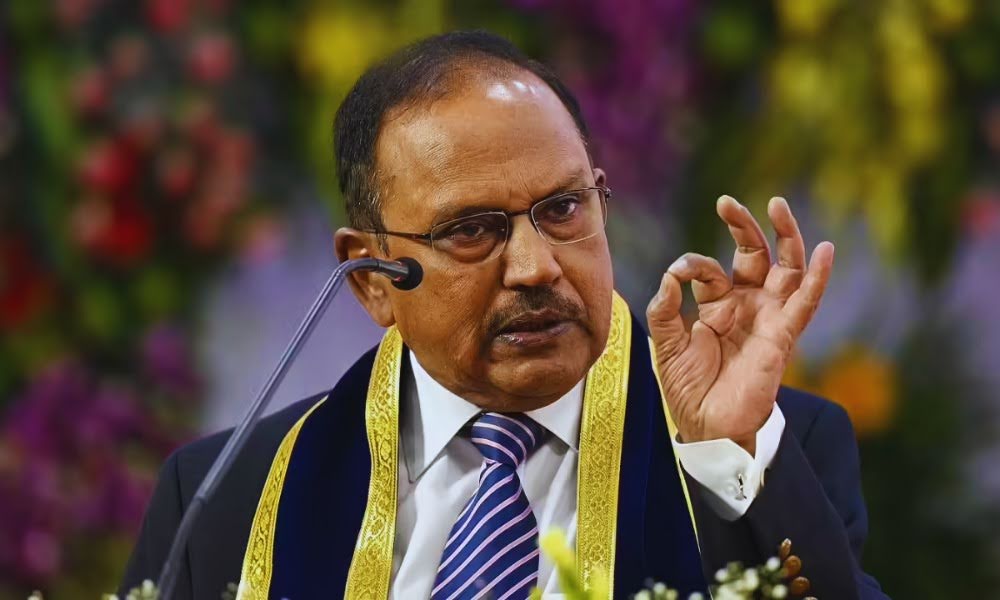
National Security Advisor Ajit Doval, while speaking at the 62nd convocation of IIT Madras, took strong exception to the way foreign media reported Operation Sindoor.
He challenged their claims and demanded evidence of any damage caused to Indian infrastructure by Pakistani strikes.
Doval said, “Foreign press said that Pakistan did that and this. You tell me one photograph, one image, which shows any damage to any Indian (structure), even a glass pane having been broken.”
He pointed out that the only available images were those showing damage to Pakistani air bases after May 10, including locations like Sargodha, Rahim Yar Khan, and Chaklala.
He stressed, “I am only telling you what the foreign media put out on the basis of images. We are capable of doing it (damage to Pakistani air bases).”
Details of India’s Precision Operation
Operation Sindoor was India’s military response to the Pahalgam terror attack.
On the night of May 9 and 10, the Indian Air Force, supported by other forces, carried out targeted strikes on Pakistani air bases across the country. The attacks also severely damaged Chinese-supported air defence systems in Pakistan.
According to sources in the defence establishment, around 15 BrahMos missiles were fired to incapacitate Pakistan’s capability to launch aircraft and operations. The objective was to disrupt the operational command of the Pakistan Air Force.
Emphasis on Indigenous Defence Capabilities
During his address, Doval stressed the importance of developing indigenous defence technologies.
Referring to the role of indigenous systems in Operation Sindoor, he said, “We are really proud of how much of indigenous content was there. We are proud of that some of the best systems were there, whether it was BrahMos missiles, whether it was our integrated air control and command system, whether it was our radars.”
He further stated that the strikes were highly precise, targeting nine terror sites deep inside Pakistan, far from the border.
“We decided to have 9 terrorist targets in the criss-cross of Pakistan, it was not in the border areas. We hit nowhere else except that. It was precise to the point where we knew who was where. Entire operation took 23 minutes,” Doval said.
India’s Use of AI for Strategic Advantage
Doval highlighted Artificial Intelligence as a transformative tool for the future and urged for its prioritisation.
“AI is one of the great game changers. AI will change the world at a rate of every year. It will become unrecognisable from everything we do today,” he said.
He emphasized AI’s wide range of applications, including defence, machine learning, robotics, medicine, and finance. “If India is going to lead and develop, make it a focal point. This is the one area that we have to develop,” Doval added.
Akash Missile System and Defence Strength
Alongside BrahMos, the indigenously developed Akash surface-to-air missile system played a significant role in defending against Pakistani drone attacks.
The integration of these indigenous technologies contributed substantially to India’s swift and successful response during Operation Sindoor.
Background of Operation Sindoor
The operation was launched following the April 22 terror attack in Pahalgam, which claimed 26 lives.
In response, India executed strikes on nine terror infrastructure sites located in Pakistan and Pakistan-occupied Kashmir on May 7. Over 100 terrorists were killed in these attacks.
After Pakistan retaliated, Indian forces responded again on the night of May 9 and 10, significantly damaging Pakistan’s air force infrastructure, including the Nur Khan base.
The series of strikes and counterstrikes continued for four days, culminating in a mutual agreement between the DGMOs of both countries to cease hostilities on May 10.
NSA Stresses the Power of Precision and Restraint
Doval reiterated the accuracy and restraint of India’s response. He said that the operation was deliberately limited to specific terrorist targets and avoided collateral damage. “We missed none. We hit nowhere else except that,” he affirmed.
He also noted that India’s strategic capabilities and precise targeting demonstrated discipline and maturity in handling regional security threats.