PM Modi Pays Tribute to Atal Bihari Vajpayee on 7th Death Anniversary
Rich tributes were offered to former Prime Minister Atal Bihari Vajpayee on his death anniversary in Puducherry.
Lieutenant Governor K. Kailashnathan, Chief Minister N. Rangasamy, Speaker R. Selvam, Home Minister A. Namassivayam, Minister for Public Works K. Lakshminarayanan, legislators, and leaders of the ruling AINRC-BJP alliance laid floral tributes at his portrait, arranged at the Mairie Building on Beach Road.
Numerous BJP workers also gathered to honor Vajpayee, one of the party’s most respected leaders.
National Leaders Mark the Occasion
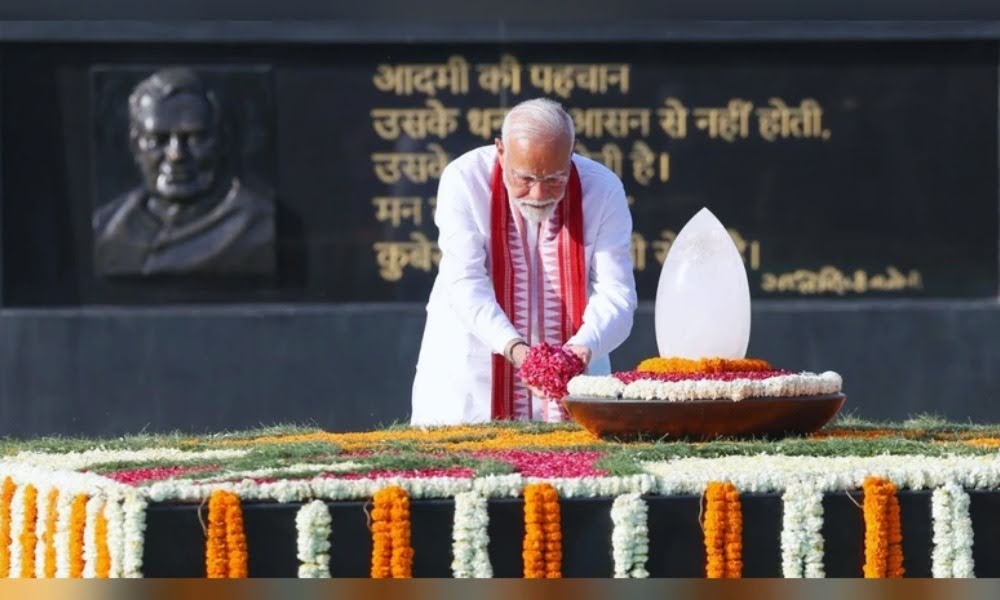
In the national capital, President Droupadi Murmu and Prime Minister Narendra Modi paid floral tributes at Vajpayee’s memorial, Sadaiv Atal.
Union Ministers Rajnath Singh, JP Nadda, Kiren Rijiju, and Gajendra Singh Shekhawat, along with Lok Sabha Speaker Om Birla and Delhi Chief Minister Rekha Gupta, were also present. Vajpayee, a towering figure of the BJP, passed away on this day in 2018.
Vajpayee’s Tenure as Prime Minister
Atal Bihari Vajpayee held the office of Prime Minister three times. His first tenure lasted only 13 days in 1996.
He returned for a second term from 1998 to 1999, which lasted 11 months, before serving a complete term from 1999 to 2004. Notably, he was the first non-Congress leader to serve a full term as Prime Minister.
Recipient of the Bharat Ratna
In recognition of his immense contributions to the nation, Vajpayee was awarded India’s highest civilian honor, the Bharat Ratna, in 2015.
Every year, dignitaries gather at Sadaiv Atal to pay respects to the veteran statesman. On Saturday, Prime Minister Modi once again paid homage at the memorial dedicated to the Bharat Ratna awardee.
Prime Minister’s Tribute
In a message posted on X, Prime Minister Modi remembered Vajpayee’s vision for India’s progress.
“Remembering Atal Ji on his Punya Tithi. His dedication and spirit of service towards the all-round progress of India continue to inspire everyone in building a developed and self-reliant India,” the post read.
Several other leaders, including Union Ministers JP Nadda, Kiren Rijiju, and Gajendra Singh Shekhawat, JD(U) MP Sanjay Jha, and Delhi Chief Minister Rekha Gupta, also paid their respects at Sadaiv Atal.
Rajnath Singh’s Message
Defence Minister Rajnath Singh also paid homage to Vajpayee. He emphasized the former Prime Minister’s lifelong dedication to India’s strength and prosperity.
“I pay homage to Atalji on his punyatithi. He worked all his life with the resolve of building a strong and prosperous India. The nation will always remember his tremendous contribution,” Singh posted on X.
The Design of ‘Sadaiv Atal’
According to the Ministry of Housing and Urban Poverty Alleviation, the Sadaiv Atal memorial is built with deep symbolism.
The central Samadhi platform consists of nine black polished granite stone blocks, capped with a central Diya.
The number nine represents Navarasas, Navaratras, and Navagrahas. Surrounding the memorial are nine bas-relief walls engraved with Vajpayee’s prose and poetry, allowing visitors to reflect upon his legacy while taking a circular walk, or “pradakshina.”
The memorial was developed by the Atal Smriti Nyas Society, formed by eminent personalities. Stones sourced from various parts of India were used in the construction, symbolizing the nation’s unity in diversity.
The Central Public Works Department (CPWD) completed the project, with its cost entirely borne by the Atal Smriti Nyas Society.
Vajpayee’s Life and Political Journey
Born on December 25, 1924, in Gwalior, Madhya Pradesh, Vajpayee became one of India’s most influential leaders. Apart from serving as Prime Minister, he held the position of External Affairs Minister from 1977 to 1979 in the cabinet of Prime Minister Morarji Desai.
A poet and statesman, Vajpayee’s eloquence and vision earned him admiration across political lines. His contributions shaped India’s political landscape for decades.
Passing of a Statesman
Atal Bihari Vajpayee passed away at AIIMS Hospital in New Delhi on August 16, 2018. His death marked the end of an era in Indian politics, but his vision, poetry, and leadership continue to inspire the nation.