Shashi Tharoor Backs Amendment Bills on Automatic Removal of Leaders Facing Serious Criminal Charges
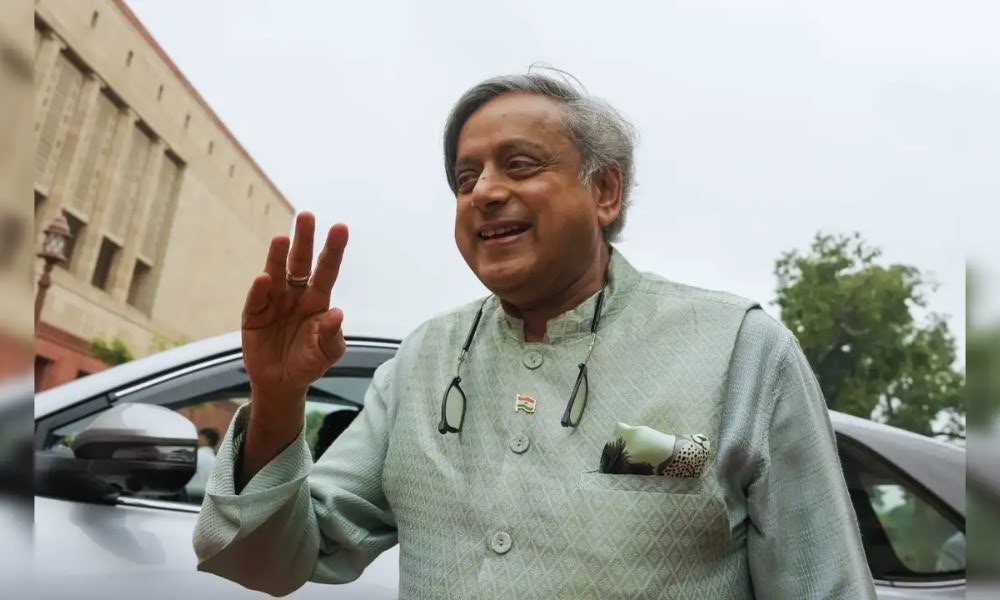
Shashi Tharoor once again found himself at a crossroads with the Congress after voicing remarks that diverged from the party’s stance.
This time, the issue concerned the Constitution (One Hundred and Thirtieth Amendment) Bill, 2025, which seeks the removal of ministers facing prolonged judicial custody.
The Amendment Bill and Its Provisions
The Constitution (130th Amendment) Bill, 2025, introduced by Home Minister Amit Shah, proposes that any minister, including the Prime Minister, Chief Ministers, or Cabinet colleagues, must resign if arrested and jailed for more than 30 consecutive days.
On the 31st day, if they do not step down voluntarily, they will be removed from office.
The bill states that the offence must carry a punishment of at least five years for this provision to apply. Once in custody for 30 days, the leader automatically ceases to hold office but can be reappointed after release by the President or Governor.
The government argues that this will bring elected leaders at par with civil servants, who are suspended upon arrest. Supporters say it will help tackle the criminalisation of politics, while critics warn it could be misused for political gain.
Opposition’s Fierce Objections
The Opposition has come out strongly against the bill, calling it unconstitutional and politically motivated.
Congress leader Priyanka Gandhi Vadra termed it a “draconian” law, warning: “Tomorrow, you can file any case against a chief minister, have him/her arrested for 30 days without conviction… and he ceases to be a chief minister? It is absolutely anti-constitutional and undemocratic.”
Abhishek Manu Singhvi echoed similar concerns, arguing that biased central agencies could use this as a tool to topple elected governments without defeating them electorally.
AIMIM chief Asaduddin Owaisi called the measure unconstitutional, while RJD’s Sudhakar Singh warned India risked resembling countries like Pakistan or Bangladesh, “where opposition leaders are either in jail or abroad.”
The uproar in Parliament was evident as Congress leader K.C. Venugopal and SP MP Dharmendra Yadav tore up copies of the bills during heated protests.
Shashi Tharoor’s Different Stance
While his party opposed the bill, Shashi Tharoor struck a contrasting note. Speaking to NDTV, he said: “If you spend 30 days in jail, can you continue to be a minister? This is a matter of common sense. I don’t see anything wrong with this.”
Tharoor, however, clarified that he had not fully studied the bill and was not extending outright support. Instead, he stressed that a discussion within committees would be useful: “I think it is good for our democracy to have a discussion within the committee… so let’s have that discussion.”
He later posted on X that his remarks were misrepresented, stating: “What I actually said vs what the media reported! I specifically stated… that I had not studied the bill but on the face of it I could see nothing wrong with the proposition that wrongdoers should resign their ministerial positions.”
Why Tharoor’s Position Matters
Tharoor’s comments come amid increasing strain in his relationship with the Congress.
His past praise for Prime Minister Modi’s “dynamism,” participation in discussions skipped by his party, and his earlier role in the G-23 dissenters’ group have all widened his distance from the Congress high command.
Although he has repeatedly denied speculation of a switch to the BJP, critics within his party believe his remarks create ambiguity.
Tharoor insists he remains loyal to Congress ideology, stating he has been committed to the party for the last 16 years.
Support from Outside Congress
Beyond Tharoor, political strategist and Jan Suraaj founder Prashant Kishor supported the bill.
He argued that the Constitution’s framers never anticipated leaders would face jail terms yet attempt to govern from prison. Kishor said: “I believe the bill is good because if a leader is accused and sent to jail, they cannot continue running the government from jail.”
BJP MLA Arvind Bellad also backed the proposal, recalling instances when chief ministers had tried to rule despite imprisonment.
Why Now?
Currently, ministers can remain in office after arrest unless convicted. Disqualification under the Representation of the People Act applies only if the conviction carries a minimum two-year sentence.
This gap was highlighted in cases like Arvind Kejriwal, who remained Delhi Chief Minister during over five months of judicial custody, and Tamil Nadu’s Senthil Balaji, who retained his ministerial role despite being in jail. The government argues the new law closes these loopholes.
A Divisive Political Moment
For the government, the bill is framed as an anti-corruption reform. For the Opposition, it represents a dangerous overreach. Within this divide, Tharoor’s remarks reveal both his independent approach and the tensions within Congress.
If passed, the bill could redefine political accountability in India, forcing resignations even without conviction, and reshaping the balance between governance and due process.