Bombay High Court Rejects CPI(M) Plea for Pro-Palestine Protest, Urges Focus on Domestic Issues
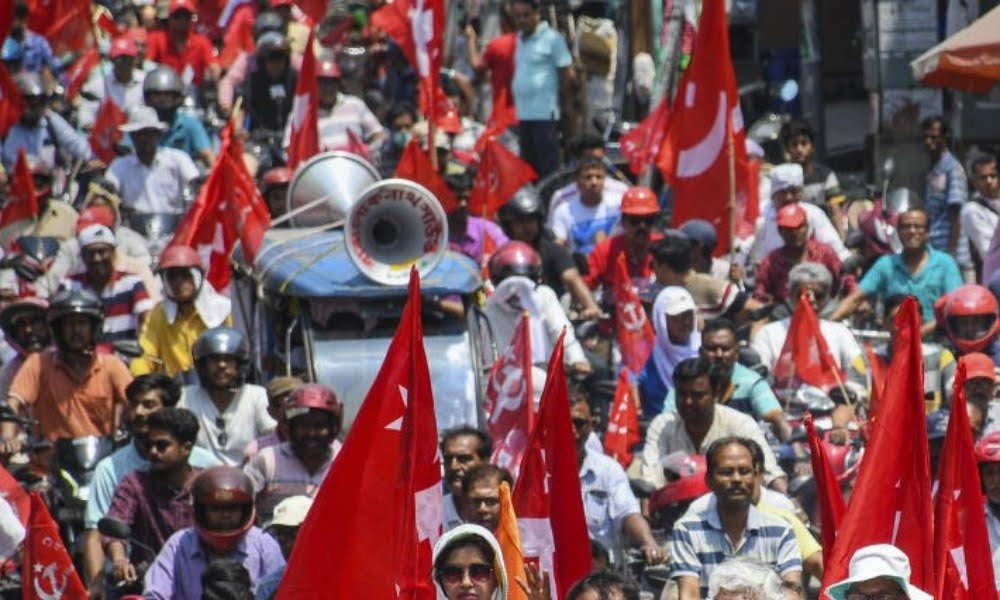
The Bombay High Court on July 25, 2025, dismissed a petition filed by the Communist Party of India (Marxist) and the Communist Party of India.
The parties had challenged the Mumbai Police’s decision to deny them permission to hold a protest at Azad Maidan over the ongoing conflict in Gaza.
The court made it clear that Indian political organisations should concentrate on national issues rather than those unfolding overseas.
Court Questions Priorities of Petitioners
The Division Bench, consisting of Justices Ravindra Ghuge and Gautam Ankhad, strongly criticised the petitioners for what it termed a misplaced focus.
“Our country has enough issues to deal with. We do not want anything like this. I am sorry to say that you are short-sighted. You are looking at Gaza and Palestine while neglecting what’s happening here. Why don’t you do something for your own country? Look at your own country. Be patriots,” the Bench stated during the proceedings.
Application for Peaceful Protest Denied by Mumbai Police
Senior advocate Mihir Desai, representing CPI(M), informed the Bench that the petitioners had applied for permission on June 13, 2025.
The proposed peaceful protest and gathering at Azad Maidan was intended to express solidarity with the people of Gaza and call for a ceasefire.
However, on June 17, the police denied the request. The refusal, addressed to the All India Peace and Solidarity Foundation (AIPSF), was issued under Section 168 of the Bharatiya Nagrik Suraksha Sanhita (BNSS) and Section 68 of the Maharashtra Police Act, 1951.
Court Emphasises Domestic Civic Engagement
The judges pointed out that political parties registered in India should be engaging with civic concerns within the country. They questioned why the CPI(M) and CPI had not taken up issues such as garbage disposal, pollution, drainage, or flooding.
The Bench remarked, “You are a registered party in India. Your party could have taken up issues like garbage dumping, pollution, drainage, or flooding. Why are you not protesting on these issues?”
Petitioners Cite India’s Foreign Policy on Palestine
The petitioners reminded the court that India’s historical support for Palestine has been an important element of its foreign policy.
India was the first non-Arab nation to recognise the Palestine Liberation Organisation in 1974 and one of the first to recognise Palestine as a state in 1988.
Additionally, in April 2024, India voted in favour of a UN Human Rights Council resolution affirming the right of Palestinians to self-determination.
The petitioners stated that their protest was a humanitarian appeal, not a challenge to national foreign policy.
Right to Protest is a Fundamental Freedom, Says Advocate
Mr. Desai also asserted that Indian citizens have a constitutional right to protest peacefully at designated public spaces.
He argued that opposition to government policy should not be misinterpreted as anti-national and that vague apprehensions of public disorder should not override basic freedoms.
He clarified that the protest had no links to Operation Sindoor or India’s border issues.
Court Warns Against Stirring Diplomatic Controversies
While dismissing the petition, the court warned that such demonstrations could disturb India’s diplomatic balance. “You don’t know the dust it could kick up. Whether to take a side for Palestine or Israel is their (Govt of India) work. Why do you want to create such a situation that the country has to take sides on this?” the Bench said.
CPI(M) Responds, Decries Court’s Remarks
Following the dismissal, CPI(M) issued a statement condemning the court’s comments. The party described the remarks as politically biased and unconstitutional.
It criticised the Bench for questioning its patriotism and appearing to align with the government’s foreign policy.
“The statement made by the High Court bench regarding the CPI(M) smacks of the bench aligning itself with the position of the Central Government,” the party said.
It also highlighted India’s long-standing solidarity with the Palestinian cause and urged citizens to resist what it described as a troubling trend in judicial attitudes toward dissent.
Balancing Protest Rights and National Interest
The case underscores the challenge of balancing the constitutional right to protest with the responsibility to maintain public order and national focus.
The High Court’s stance reflects a judicial preference for prioritising internal issues over involvement in international conflicts through public demonstrations.
This episode brings attention to the broader debate on the limits of democratic expression, patriotism, and global solidarity within the Indian political landscape.